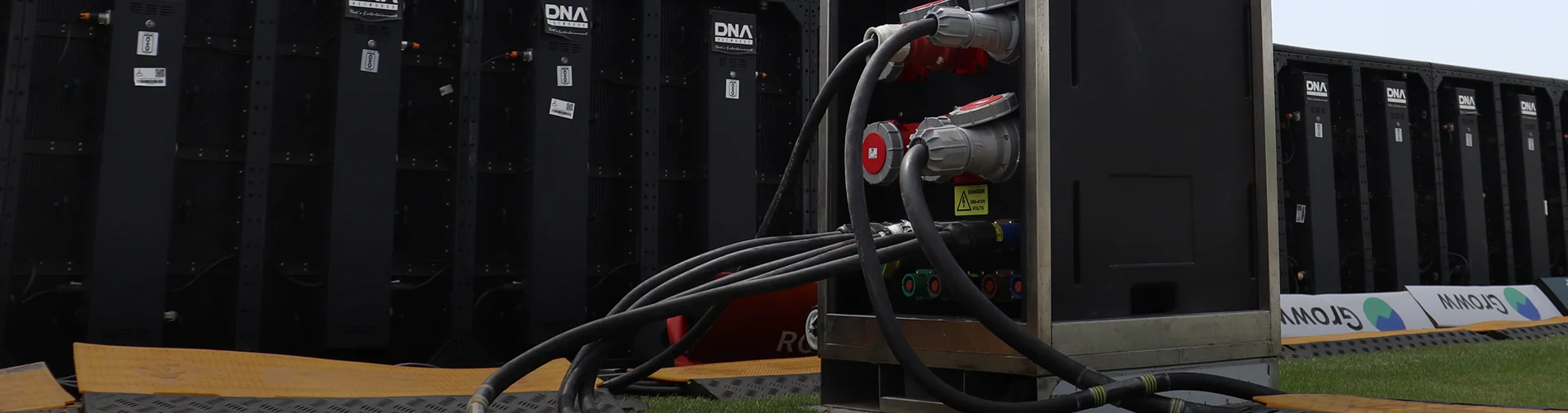
Every large-scale outdoor event relies on temporary electrical systems to power lights, sound, screens, and climate-control equipment. These systems rely on extensive cabling that must be kept safe, organized, and accessible.
Without protection, exposed cables can quickly become hazards, creating tripping risks, electrical faults, or damage from traffic and adverse weather conditions. For event planners and project managers, effective cable management is therefore a core safety and compliance requirement, not just an operational detail.
Common Cable-Related Risks
| Issue | Impact on Site Safety | Preventive Measure |
|---|---|---|
| Exposed cables across walkways | Trip hazards for guests and crew | Use cable ramps to cover and mark routes |
| Vehicles crossing active power lines | Crushed insulation and shorts | Install heavy-duty protective ramps |
| Heat and sand exposure | Cable degradation and system failure | Use sealed, UV-resistant materials |
| Disorganized cable runs | Delayed setup and difficult inspection | Plan structured, labeled cable layouts |
Cable Ramps: Core to Power Protection
Cable ramps are mechanical protection systems that shield electrical cables from load stress and environmental damage, while maintaining walking surfaces at a level and safe condition.
They are widely used across event venues, construction sites, and exhibition areas to maintain operational safety and accessibility.
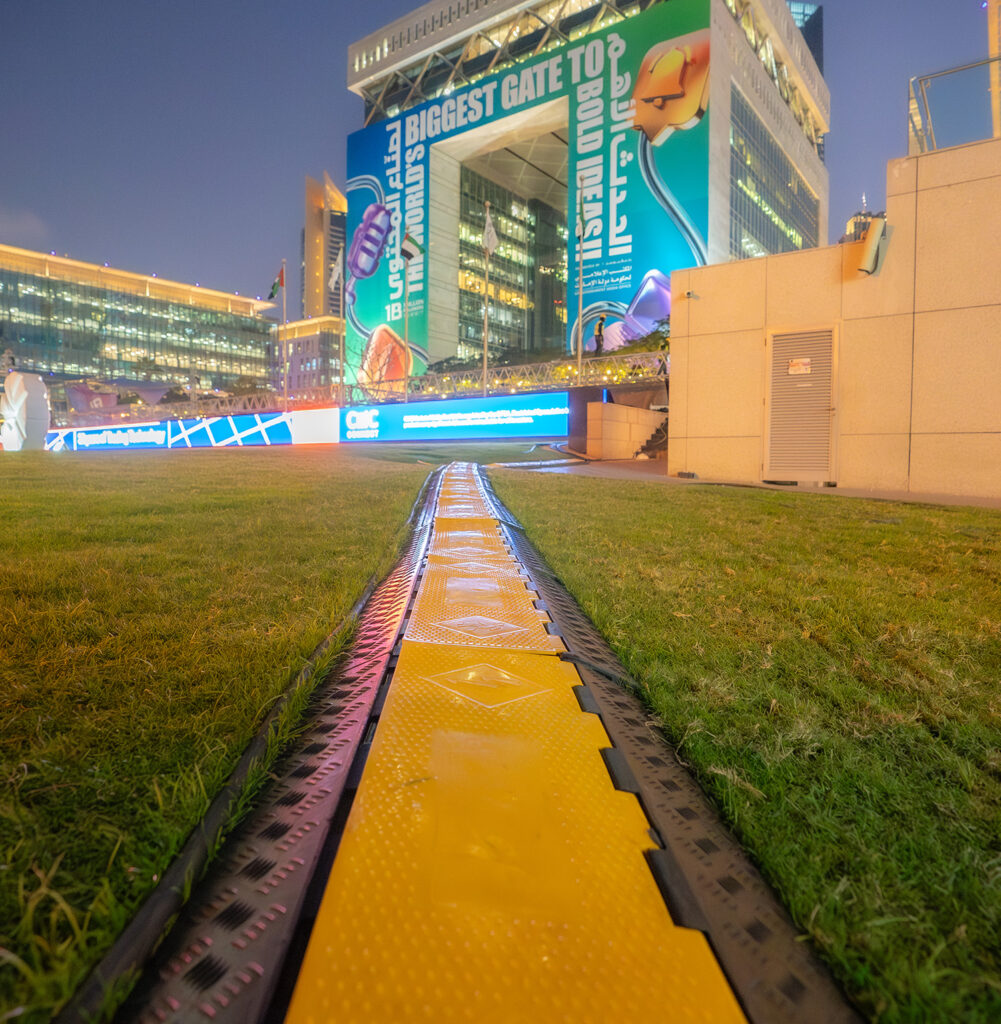
Why Use Cable Ramps
- Prevents tripping and equipment damage
- Simplifies inspection and maintenance
- Ensures compliance with UAE safety codes
- Extends cable lifespan under outdoor conditions
Types of Cable Ramps and Technical Data
| Model | Description | Channels | Dimensions (cm) | Weight | Typical Application |
|---|---|---|---|---|---|
| Single Channel | Compact ramp for single-line power or data runs | 1 CH | 100 × 15 × 3 | 3 kg | Light-duty pedestrian areas |
| Double Channel | Mid-capacity ramp for two power lines | 2 CH | 100 × 25 × 5 | 6.2 kg | Small stages and vendor zones |
| Triple Channel | Standard event ramp for three separate circuits | 3 CH | 90 × 45 × 6 | 9 kg | General event walkways and equipment zones |
| Heavy Duty (5-Channel) | High-capacity ramp for vehicle or forklift crossings | 5 CH | 90 × 50 × 5 | 13 kg | Access roads and logistics areas |
| ADA-Compliant (1-Channel) | Low-slope design for wheelchair and accessibility routes | 1 CH | 100 × 85 × 3 | 9.68 kg | Public zones requiring barrier-free access |
All models are constructed from UV-stable, industrial-grade polyurethane suitable for Dubai’s outdoor conditions.
Each unit interlocks for modular extension and features a non-slip surface for improved safety.
View specifications: Cable Ramp Rental Solutions
Planning Cable Routes Effectively
When designing an event site, early coordination between the electrical engineer, event planner, and safety officer ensures that power distribution and cable routing follow safe and efficient principles:
- Map cable paths before installation to prevent congestion
- Separate power, signal, and lighting circuits to minimize interference
- Position ramps in high-traffic areas and mark them clearly
- Keep junctions accessible for inspection or emergency shutdown
- Verify load limits and ramp placement before vehicle movement
Safety, Accessibility, and Compliance
Dubai’s environmental conditions—high heat, humidity, and sand—require IP-rated equipment and mechanical protection to ensure continuous operation.
Cable ramps provide not only physical protection but also contribute to site accessibility, especially when ADA-compliant models are used in guest areas.
By maintaining level crossings and visible pathways, event teams can meet local safety standards while promoting inclusivity and reducing liability exposure.
Conclusion
- Cable management is an engineering discipline central to outdoor event design.
- Ramps protect cables from mechanical and environmental damage while maintaining accessibility.
- 3-channel and ADA-compliant ramps are critical in public areas where both safety and mobility access are required.
- Planning, labeling, and inspection routines should be integrated into every event’s electrical layout.