Rare equipment. Hotels lose climate control and guest services. Data centers risk unplanned server shutdowns. Factories stop mid-production. Construction sites lose lighting and crane operations after sundown.
These are not hypothetical scenarios. Grid interruptions, transformer failures, scheduled maintenance shutdowns, and demand surges during peak summer months are realities that every business must plan for. The question is not whether a power disruption will happen, but whether your facility is prepared when it does.
This guide covers the essential components of an emergency power contingency plan, with practical guidance for five of the most power-dependent sectors: healthcare, hospitality, data centers, industrial manufacturing, and construction and port operations. Whether you manage a hospital wing or a container terminal, the principles of preparedness remain the same: assess your risk, size your backup correctly, and partner with a provider that can deploy within hours, not days.
Why Power Contingency Planning Matters
Even modern, reliable electrical grids are not immune to disruption. Several factors make contingency planning especially important for businesses operating in hot climates and fast-growing regions.
Extreme heat places enormous strain on cooling systems and transformers during summer months, when ambient temperatures regularly exceed 45°C. Peak demand periods increase the likelihood of localized grid stress. Rapid development and ongoing infrastructure expansion means temporary supply interruptions during upgrades are common. Unforeseen disruptions such as equipment failures at substations, cable faults, severe weather events, flooding, sandstorms, or even supply chain issues affecting fuel and spare parts can trigger outages with little or no warning. Cyberattacks on critical infrastructure, construction accidents damaging underground cables, and sudden surges from neighbouring grid zones are also growing risks that no facility can fully predict. Natural and man-made crises, including earthquakes, industrial accidents, fires in nearby facilities, geopolitical tensions affecting energy supply chains, and large-scale civil emergencies, can cause prolonged grid instability or total blackouts that extend far beyond routine maintenance windows. Regulatory expectations from local electricity authorities and civil defense bodies require facilities in critical sectors to maintain backup power capabilities.
For industries where even minutes of downtime carry serious consequences, a written and tested contingency plan is not optional. It is a core part of operational risk management.
KEY FACT
According to industry benchmarks, unplanned downtime costs businesses between $15,000 and $150,000 per hour depending on the sector, with data centers and healthcare facilities at the highest end of that range.
Step 1: Assess Your Power Risk Profile
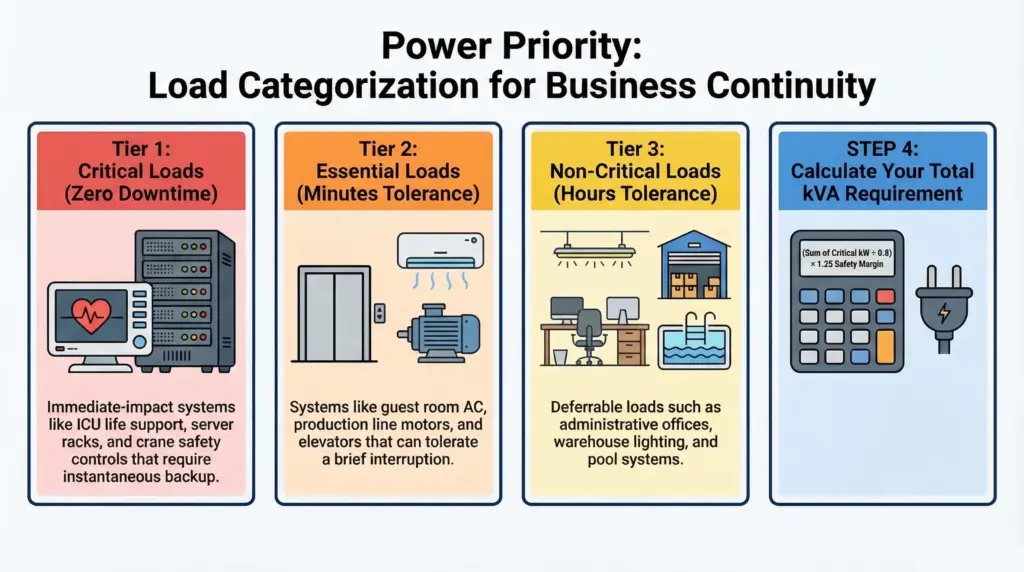
Every effective contingency plan starts with a risk assessment. This means understanding not just your total power demand, but which loads are critical, which are deferrable, and how quickly backup power must engage.
Identify Critical vs. Non-Critical Loads
Not all electrical loads carry equal urgency. A hospital’s ICU ventilators cannot tolerate even a momentary interruption, while its administrative office lighting can wait. A hotel’s elevator systems and emergency lighting take priority over poolside speakers. A data center’s server racks need uninterrupted power, while its office HVAC can cycle down temporarily.
| Sector | Critical Loads (Zero Downtime) | Essential Loads (Minutes Tolerance) | Non-Critical Loads (Hours Tolerance) |
|---|---|---|---|
| Hospitals & Healthcare | Life support, surgical theatres, ICU monitoring, pharmacy refrigeration | Emergency lighting, nurse call systems, elevators | Admin offices, non-clinical HVAC, cafeteria |
| Hotels & Hospitality | Emergency lighting, fire alarm panels, elevators, security systems | Guest room AC, lobby lighting, kitchen refrigeration | Pool systems, spa equipment, landscape lighting |
| Data Centers & Telecom | Server racks, network switches, cooling for server rooms | Security systems, fire suppression, monitoring | Office areas, meeting rooms |
| Industrial & Manufacturing | Process control systems, safety interlocks, fire suppression | Production line motors, conveyor systems, compressed air | Warehouse lighting, break rooms, admin offices |
| Construction & Ports | Crane safety systems, dock navigation lights, fuel handling controls | Tower cranes, welding stations, material hoists | Site offices, worker amenities, perimeter lighting |
Calculate Your Total Backup Power Requirement
Once you have mapped your critical and essential loads, calculate the total kVA (kilovolt-ampere) requirement. A common formula:
Total Backup kVA = (Sum of all critical loads in kW) ÷ Power Factor (typically 0.8) × Safety Margin (1.25)
For example, a mid-sized hotel with 200 kW of critical and essential loads would need: 200 ÷ 0.8 × 1.25 = 312.5 kVA minimum backup capacity.
SIZING TIP
Always add a 25% safety margin to your calculated load. This accounts for motor starting currents, future load additions, and prevents your generator from running at maximum capacity, which reduces fuel efficiency and equipment lifespan.
Step 2: Select the Right Emergency Power Equipment
With your load profile defined, the next step is choosing the right combination of equipment. Emergency power backup is rarely just a generator. A complete system typically includes generation, switching, distribution, fuel supply, and in many cases, cooling.
Generators: Matching Capacity to Need
Generator rental is the foundation of any emergency power plan. The key is selecting the right capacity for your facility’s needs.
| Application | Typical Load Range | Recommended Generator Size | Example Use Case |
|---|---|---|---|
| Small clinic or boutique hotel | 20 – 50 kW | 30 – 80 kVA | Emergency lighting, basic AC, refrigeration |
| Medium hospital wing or resort | 100 – 300 kW | 150 – 400 kVA | Full critical systems, guest comfort, kitchens |
| Data center or telecom facility | 200 – 800 kW | 300 – 1,250 kVA | Server racks, precision cooling, UPS charging |
| Manufacturing plant | 300 – 1,000 kW | 400 – 1,250 kVA | Production lines, compressors, process systems |
| Construction site or port | 50 – 500 kW | 80 – 600 kVA | Cranes, welding, tower lights, site facilities |
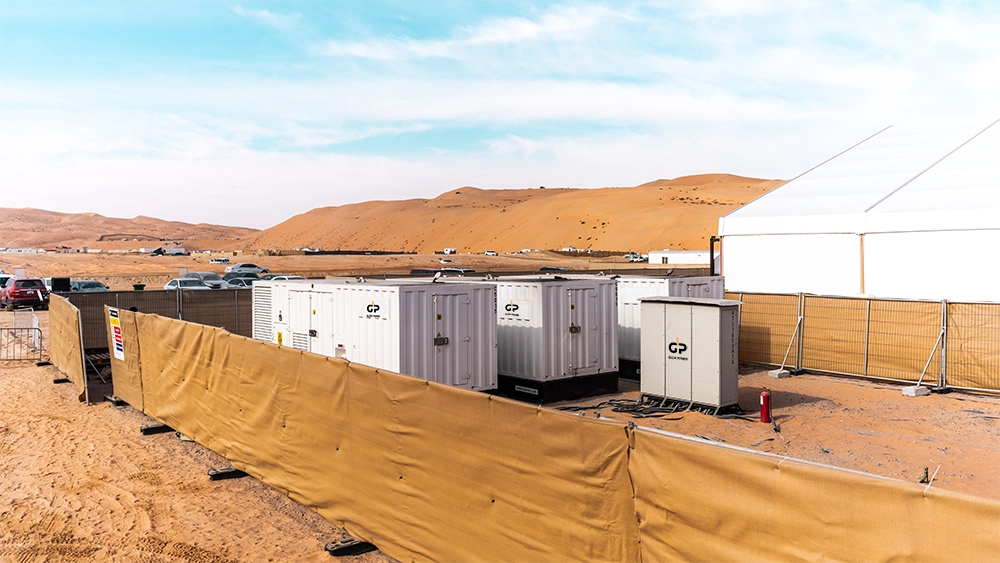
For large facilities requiring more than 1,250 kVA, multiple generators can be synchronized (paralleled) to deliver combined output while maintaining redundancy. If one unit requires maintenance, the remaining generators continue supplying power without interruption.
Glow Power Rental offers diesel generators from 30 kVA to 1,250 kVA, covering the full range of emergency backup requirements.
Automatic Transfer Switches: Seamless Switchover
An Automatic Transfer Switch (ATS) is what makes backup power truly automatic. When the ATS detects a grid failure, it signals the generator to start and transfers the electrical load from the mains to the generator, typically within 10 to 15 seconds. When grid power returns, the ATS transfers back automatically.
For hospitals and data centers, this automatic switchover is essential. Manual transfer introduces human delay and error, which is unacceptable where patient safety or server uptime is at stake.
HEALTHCARE SAFETY NOTE
Hospitals and healthcare facilities should pair ATS units with an Uninterruptible Power Supply (UPS) for critical loads like ventilators and monitors. The UPS bridges the 10-15 second gap between grid failure and generator startup, ensuring zero interruption to life-support equipment.
Power Distribution: Getting Power Where It Is Needed
Once generated, power must be safely distributed across your facility. Electric distribution boards and secondary distribution units split the generator output into multiple protected circuits, each with its own breaker and overload protection.
For industrial plants and construction sites, totalizing panels allow multiple generators to feed into a single distribution system, simplifying the connection between generation and load.
Cooling Equipment: Protecting People and Processes
In hot climates, power outages do not just stop equipment. They stop cooling. Within minutes, indoor temperatures can begin climbing toward dangerous levels. Hospitals risk medication spoilage and patient discomfort. Hotels face guest complaints and potential health and safety issues. Data centers risk thermal shutdowns as server room temperatures exceed operating thresholds.
Cooling equipment rental should be part of every emergency plan for facilities that depend on climate control. Portable AC units ranging from 5-ton to 25-ton capacity can be deployed rapidly, while portable chillers serve larger facilities requiring 100 to 200 tons of cooling capacity.
Fuel Supply: Planning for Extended Outages
Generators require a reliable fuel supply to remain operational. For outages lasting more than a few hours, fuel tank rental ensures your generators can run continuously. Fuel tanks from 957 to 4,460 litres provide the extended runtime that hospitals during emergencies, hotels during peak season, and factories mid-production run all require.
FUEL PLANNING TIP
A 500 kVA generator at 75% load consumes roughly 75 to 90 litres of diesel per hour. For a 24-hour outage, you would need approximately 1,800 to 2,160 litres. Always plan fuel reserves for at least 150% of your expected outage duration.
Tower Lights: Maintaining Safety After Dark
For construction sites and port operations, a power outage at night creates immediate safety hazards. Workers cannot see obstacles, vehicles cannot navigate safely, and security is compromised. Tower light rental provides self-contained lighting units that operate independently of the site’s main power, keeping work areas visible and safe during any outage.
Step 3: Build Your Response Protocol
Having the right equipment matters, but knowing when and how to deploy it matters more. Your contingency plan should include a clear response protocol that your team can execute under pressure.
Define Response Tiers
| Tier | Trigger | Response Time Target | Actions |
|---|---|---|---|
| Tier 1: Automatic | Grid failure detected by ATS | 10 – 15 seconds | ATS activates standby generator; critical loads transfer automatically |
| Tier 2: Rapid Manual | Extended outage confirmed (30+ minutes) | 30 – 60 minutes | Deploy portable cooling; activate fuel logistics; notify management |
| Tier 3: Sustained | Outage exceeds 4 hours or utility confirms extended disruption | 2 – 4 hours | Request additional rental generators; establish fuel resupply schedule; activate full contingency protocol |
Assign Roles and Communication Channels
Every contingency plan needs named individuals responsible for each tier. Identify who authorizes equipment rental, who contacts the power rental provider, and who communicates with building occupants or clients. Document mobile numbers, WhatsApp groups, and backup communication methods. During a power outage, your office phone system and email servers may be down too.
Test Your Plan Regularly
A plan that has never been tested is a plan that will fail under pressure. Schedule quarterly drills that simulate a full power outage. Run your backup generator under load. Verify that the ATS switches correctly. Confirm your fuel supplier can deliver within the agreed timeframe. Update your plan after every test and after every real incident.
BEST PRACTICE
Keep a printed copy of your emergency power contingency plan in a known location. Digital documents are inaccessible during a power outage if your servers and network are down.
Step 4: Ensure Safety and Regulatory Compliance
Emergency power installations must meet the same safety standards as permanent electrical systems.
Key Safety Considerations
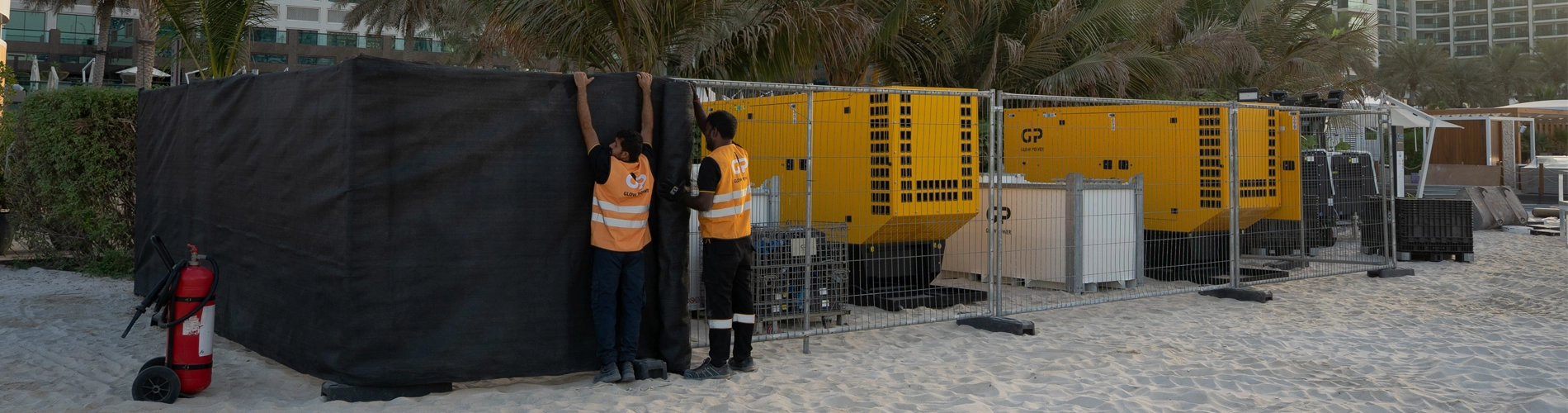
Generator placement requires adequate ventilation, minimum clearance distances from buildings and air intakes, and secondary fuel containment to prevent spills. Never operate diesel generators indoors or in enclosed spaces due to carbon monoxide risk.
Electrical connections must be performed by qualified electricians. All temporary distribution boards should be IP-rated for the environment (IP65 or higher for outdoor or dusty conditions), fitted with RCD (residual current device) protection, and tested for insulation resistance and earth-fault loop impedance before energization.
Fuel handling requires proper storage, bunding, and fire suppression measures. All fuel storage tanks should be double-walled or placed within secondary containment.
SAFETY WARNING
All temporary electrical installations must be inspected and approved by a licensed electrical contractor before energization. Ensure your power rental provider supplies equipment with current test certificates and maintenance records.
Step 5: Partner with a Reliable Emergency Power Provider
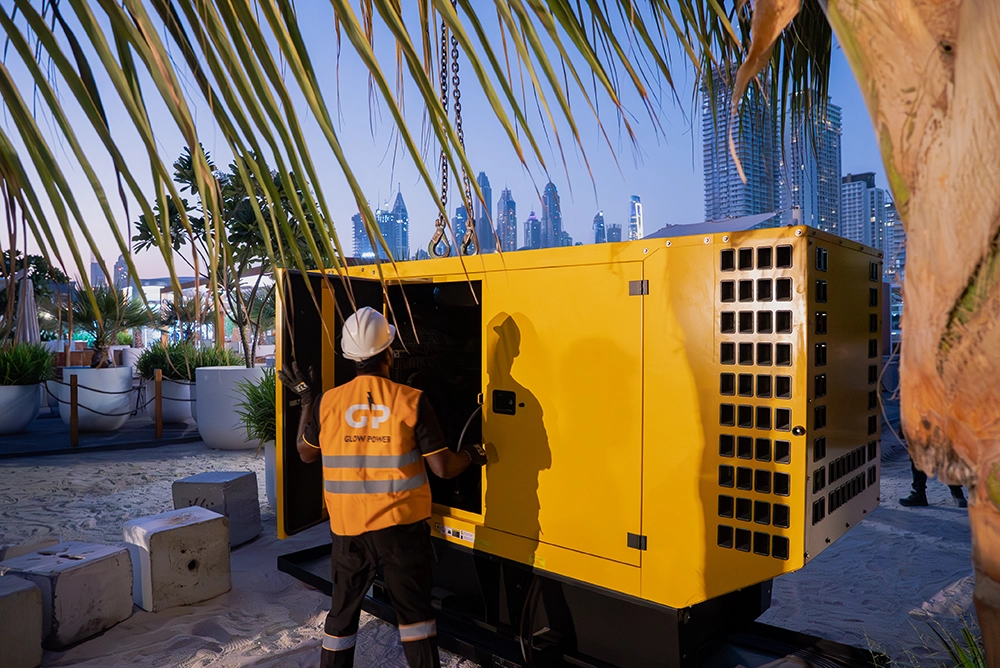
The final component of your contingency plan is your power rental partner. When an outage strikes at 2 AM on a Friday, you need a provider that answers the phone and has equipment ready to move.
What to Look for in an Emergency Power Partner
24/7 availability is non-negotiable. Power outages do not follow business hours. Your provider must have a round-the-clock operations desk and on-call technicians.
Same-day deployment capability means the provider maintains an inventory of pre-tested, fuelled generators and cooling units ready for immediate dispatch. Ask about their typical response time within your region.
Complete ecosystem means your provider can supply not just generators, but also ATS panels, distribution boards, power cables, cooling equipment, fuel tanks, and tower lights as a single coordinated deployment. This eliminates the risk of incompatible equipment from multiple vendors.
Fuel logistics for extended outages requires a provider with established fuel supply chain capability, including scheduled refuelling and emergency top-ups.
| Capability | Why It Matters | Questions to Ask |
|---|---|---|
| 24/7 hotline | Outages happen at night and on weekends | What is your after-hours response time? |
| Same-day delivery | Extended delays multiply downtime costs | Do you guarantee same-day deployment? |
| On-site technicians | Safe connection and monitoring during outage | Will a qualified technician remain on-site? |
| Equipment range | One provider reduces coordination risk | Can you supply generators, ATS, distribution, cooling, and fuel? |
| Maintenance records | Reliable equipment prevents secondary failures | Can you provide test certificates for all units? |
| Fuel management | Generators need continuous fuel for extended outages | Do you offer scheduled refuelling and emergency fuel delivery? |
Frequently Asked Questions
How quickly can a rental generator be deployed in an emergency?
Established rental providers with pre-tested inventory can deliver and commission a generator within hours of your call. Same-day deployment is standard for providers that maintain ready stock. For critical facilities like hospitals and data centers, pre-arranged standby agreements with your rental provider can reduce this to under two hours.
What size generator does a hospital need for emergency backup?
Hospital generator sizing depends on which systems require backup. A small clinic with basic critical loads may need 80 to 150 kVA. A medium hospital wing covering ICU, surgical theatres, pharmacy refrigeration, and emergency lighting typically requires 300 to 600 kVA. Large hospitals with full-facility backup often need 800 to 1,250 kVA or multiple synchronized units. Always consult with a qualified engineer to perform a detailed load analysis.
Can rental generators power a hotel’s air conditioning during an outage?
Yes, but sizing is critical. Air conditioning represents the largest electrical load in most hotels, often accounting for 50 to 60% of total demand. A mid-sized hotel may need a 500 kVA generator or larger to maintain guest room AC alongside emergency lighting and kitchen operations. Bundling a generator with portable AC units is an effective approach when the hotel’s central HVAC plant cannot be backed up economically.
What is an Automatic Transfer Switch and does my facility need one?
An Automatic Transfer Switch (ATS) monitors your mains supply and automatically switches to generator power when it detects an outage. It eliminates the need for manual intervention, reducing switchover time to 10 to 15 seconds. Any facility where downtime carries safety, financial, or reputational risk should install an ATS as part of its contingency plan. This includes hospitals, data centers, hotels, and industrial plants with continuous processes.
How long can a rental generator run continuously?
Diesel generators are designed for extended operation and can run continuously for days or weeks with proper maintenance and fuel supply. The limiting factor is fuel. A 500 kVA generator at 75% load consumes approximately 75 to 90 litres per hour. With a 4,460-litre fuel tank, you would have roughly 50 to 60 hours of runtime before refuelling. Scheduled fuel delivery ensures uninterrupted operation for as long as needed.
Conclusion
Power outages are an operational reality, not a question of “if” but “when.” The businesses that survive them without disruption are the ones that planned ahead: they assessed their critical loads, selected the right combination of backup equipment, established clear response protocols, and partnered with a provider capable of same-day deployment and 24/7 support.
Whether you are protecting patients in a healthcare facility, maintaining guest comfort in a hotel, ensuring server uptime in a data center, keeping a production line running, or maintaining site safety at a construction site or port, the principles are the same. Assess, plan, equip, and test.