In the UAE’s power-driven economy, fuel storage is the silent backbone of every project from tower cranes and site generators to event lighting systems and film productions. Reliable storage ensures safety, compliance, and continuity, especially when working under tight deadlines and harsh environmental conditions.
Yet, not all fuel tanks are built or managed equally. The difference between a compliant, professionally maintained fuel system and an improvised one can mean the difference between operational uptime and costly shutdowns.
This article explores the technical types of fuel tanks, their pros and cons, and why renting certified bunded tanks has become the smarter, safer choice for businesses in construction, events, and film production sectors across the UAE.

Understanding Fuel Tanks
A fuel tank is a sealed vessel designed to store liquid fuels like diesel, biodiesel, or gasoline. Its role extends far beyond “holding fuel” it must maintain integrity under pressure, prevent contamination, resist corrosion, and comply with fire and environmental codes.
Common Tank Configurations
| reType | Construction | Applications | Compliance Level |
|---|---|---|---|
| Single-Wall Tank | One steel or HDPE layer | Internal plant use, small generators | Low — requires external bund walls |
| Bunded (Double-Wall) Tank | Inner tank + outer containment shell | Construction, events, remote film sets | High — meets DCD/DoE safety codes |
| Underground Tank (UST) | Buried steel tank with piping | Fuel stations, logistics depots | High — complex installation |
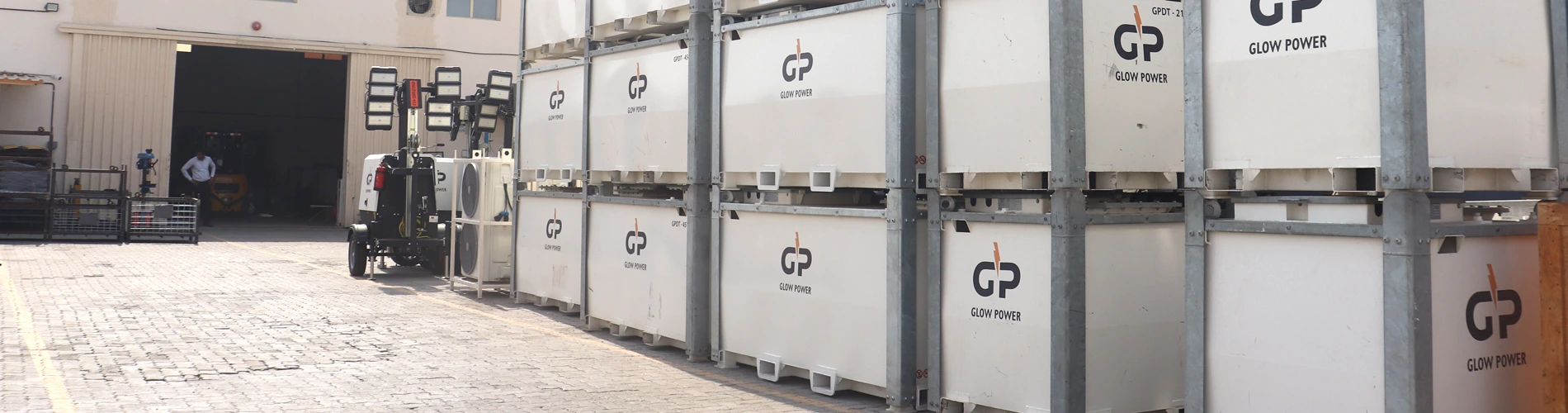
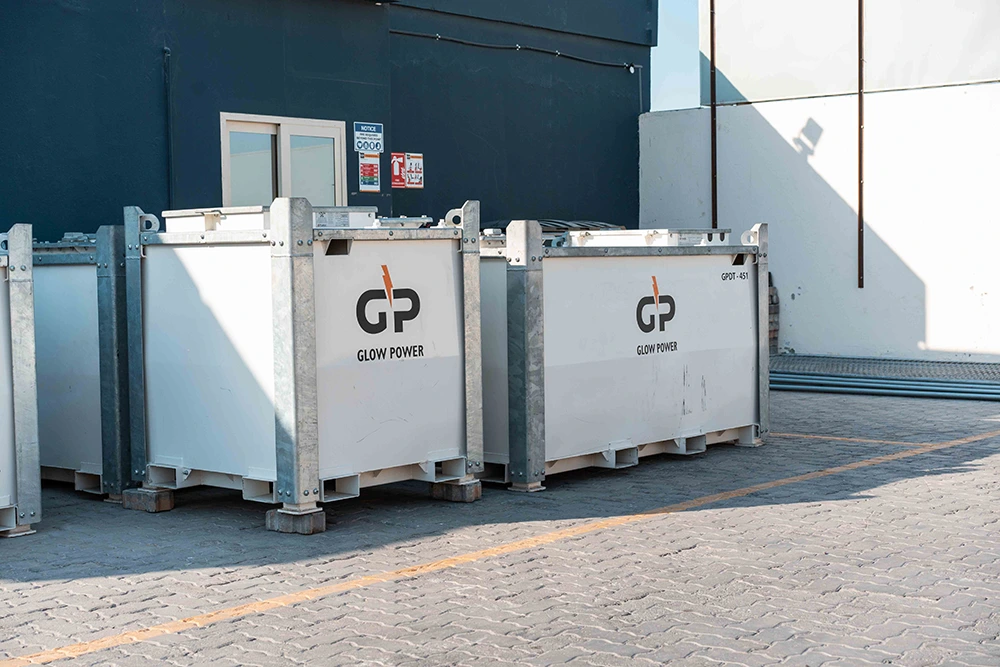
| Mobile / Skid Tank | Portable, skid-mounted, forklift pockets | Temporary sites, mobile gensets | High — transportable and compliant |
| Composite Plastic Tank | HDPE or fiberglass | Light-duty or low-volume use | Medium — UV and capacity limitations |
Anatomy of a Double-Wall (Bunded) Tank
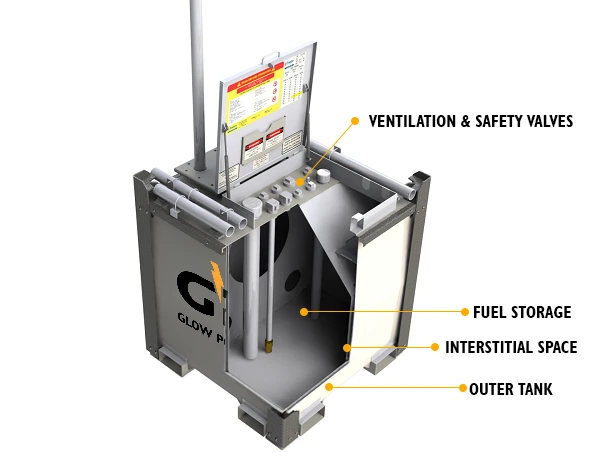
A double-wall fuel tank — often called a bunded tank — consists of two independent layers that together form a primary containment system (for storing the fuel) and a secondary containment system (for capturing leaks or overflows).
Structural Breakdown
| Layer | Component | Technical Description | Function |
|---|---|---|---|
| Inner Tank | Primary Fuel Chamber | Fabricated from mild steel (EN 10025) or stainless steel, welded to API or BS EN standards. | Stores diesel or HVO fuel under atmospheric conditions. |
| Outer Tank (Bund) | Containment Shell | Surrounds the inner tank on all sides, typically 110–120% of its capacity. Coated for corrosion and UV protection. | Captures any leak, crack, or overfill from the inner tank. |
| Interstitial Space | Gap Between Walls | Air or vacuum space fitted with a leak detection sensor, pressure gauge, or float alarm. | Provides early warning of leaks without releasing fuel into the environment. |
| Access Ports & Manholes | Service Openings | Allow inspection, cleaning, and refilling operations. Typically sealed with bolted covers and gaskets. | Safe access for maintenance and sampling. |
| Ventilation & Safety Valves | Breather, pressure/vacuum valves, flame arrestors. | Manage pressure fluctuations due to temperature changes. | Prevent structural stress and vapor accumulation. |
| Base Frame / Skid | Support & Lifting Structure | Integrated steel frame with forklift pockets and tie-down points. | Enables mobility and secure anchoring on uneven sites. |
How the System Works
- Fuel Storage: The inner tank holds the diesel or biodiesel fuel used for power generation or equipment operation.
- Containment Protection: The outer bund acts as a secondary shell, preventing any leak or rupture from escaping into the ground.
- Leak Detection: Sensors within the interstitial space send alerts through a gauge or automatic tank gauging (ATG) system if fuel enters the gap for sensor-monitored tanks.
- Pressure Management: Breather and pressure-vacuum valves maintain structural integrity as temperatures fluctuate — critical in UAE’s desert climate.
- Dispensing & Monitoring: Fitted pumps, level gauges, and telemetry units ensure precise control of fuel usage and remote monitoring.
The Harsh Reality: Challenges of Fuel Storage in the UAE
Project sites across the Emirates face unique challenges:
- Ambient temperatures exceeding 50 °C, causing fuel expansion and gasket fatigue.
- Sand, salt, and humidity accelerating corrosion and abrasion.
- Tight site footprints, especially at events and film sets.
- Strict DCD and DOE inspections, where non-compliant tanks can stop work entirely.
In these conditions, using uncertified or single-wall tanks is more than a risk — it’s a liability.
Pros and Cons of Common Fuel Tank Types
| Type | Advantages | Disadvantages |
|---|---|---|
| Single-Wall | Low cost, quick setup | Leak-prone, requires bund pit, non-compliant for outdoor UAE sites |
| Bunded (Double-Wall) | Leak-proof, compact, DCD-compliant, protects from heat and impact | Slightly higher upfront or rental cost |
| Underground | Saves surface space, stable temperature | Expensive installation, hard to inspect, long approval time |
| Mobile / Skid | Fast deployment, ideal for temporary projects, built-in bund | Lower capacity, frequent refueling needed |
| Plastic (HDPE) | Corrosion-free, lightweight | Limited UV resistance, not suitable for long-term diesel storage |
The True Cost of “Cheap” Fuel Storage
Many project managers initially opt for single-wall or basic tanks to cut capital cost — only to face unseen operational expenses later:
- Leak cleanups and soil remediation costing tens of thousands of dirhams.
- Civil Defence penalties for unbunded storage.
- Fuel wastage due to evaporation and unsealed fittings.
- Downtime caused by unapproved or unsafe installations.
Over a 2- to 3-year period, these indirect costs far exceed the price difference between standard and bunded systems.
Why Bunded Tanks Are the Industry Standard
Built-In Safety
The dual-wall design captures leaks and prevents spills — even under thermal expansion or accidental impact.
Regulatory Compliance
Bunded tanks meet local regulations and are approved by Dubai Civil Defence (DCD) and Abu Dhabi DoE, fulfilling the required 110% containment rule and simplifying permit approvals and inspections.
Durability in Desert Conditions
Powder-coated steel and anti-corrosion liners ensure resilience against UV, salt, and sand.
Space Efficiency
Self-contained design eliminates the need for external bund walls or containment pits — ideal for tight urban or event spaces.
Integration Ready
Most modern bunded tanks come with:
- Quick-connect couplings for generators.
- Automatic Tank Gauging (ATG) sensors.
- Overfill and leak alarms with GSM telemetry.
Financial Advantage
While purchase cost is higher, renting or using bunded tanks:
- Reduces environmental liability.
- Lowers insurance premiums.
- Increases site uptime.
- Eliminates disposal and inspection ownership costs.
Renting vs. Owning Fuel Tanks
For many UAE operators, renting fuel tanks is a strategic choice, not just a financial one.
| Factor | Renting | Owning |
|---|---|---|
| Initial Cost | Minimal | High CapEx investment |
| Maintenance | Included in rental | Owner’s responsibility |
| Compliance | Managed by supplier | Requires internal inspection & renewal |
| Flexibility | Scalable per project | Fixed asset |
| Deployment Speed | Immediate (plug-and-play) | Dependent on procurement & approvals |
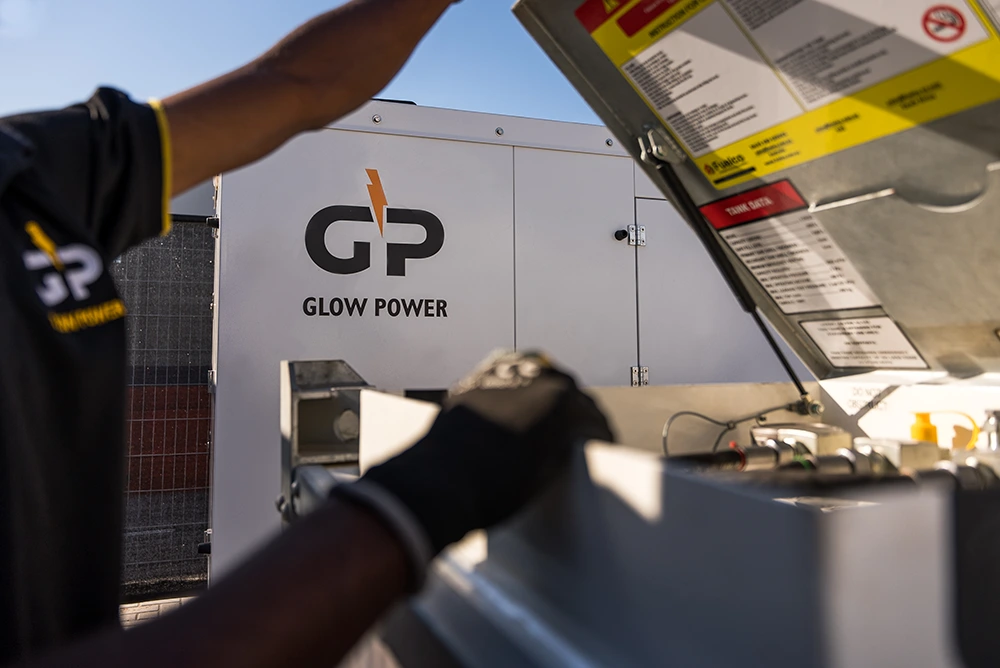
Renting from a certified provider like Glow Power Rental ensures every tank is pre-inspected, pressure-tested, DCD-compliant, and delivered site-ready — saving days in mobilization time.
Industry Applications
Construction:
Used for generators, tower cranes, and site equipment — bunded tanks minimize leakage risk in sand or uneven terrain.
Event Power:
Ideal for concerts, exhibitions, and outdoor activations where aesthetics, compact layout, and zero-spill safety are crucial.
Film & Media Production:
Mobile tanks supply clean fuel to generators without disrupting shooting schedules. Their compact design ensures safe placement near crew zones.
Remote Industrial Operations:
At oilfields or remote camps, bunded tanks reduce maintenance trips and integrate easily with telemetry systems.
The Future of Fuel Storage in the UAE
As the nation moves toward Net Zero 2050, fuel storage systems are evolving.
Expect the next generation of tanks to feature:
- IoT connectivity for remote monitoring and predictive maintenance.
- Compatibility with low-emission fuels such as HVO.
- Hybrid systems with solar telemetry and automatic refill scheduling.
Glow Power Rental already integrates smart monitoring systems into its fleet — giving clients real-time visibility on consumption, refueling cycles, and environmental performance.
Choosing the Right Tank for Your Project
When evaluating suppliers, ensure the following:
- Tanks meets local regulations and are DCD-approved and ISO 9001 certified.
- Containment volume ≥ 110 % of fuel capacity.
- Leak detection sensors and automatic shutoff valves are installed.
- Coating system rated for C5-M corrosion class (coastal exposure).
- Vendor provides test certificates, inspection reports, and bund integrity records.
Glow Power Rental meets all these criteria — and provides on-site delivery, setup, and maintenance with optional fuel management services.
Conclusion
Fuel tanks are more than steel containers; they’re the foundation of safe, continuous power for every operation in the UAE.
For project managers, engineers, and event planners, the decision isn’t whether to use a bunded tank — it’s whether to own one or rent a fully compliant, pre-maintained system that performs from day one.
By renting DCD-certified bunded fuel tanks from Glow Power Rental, you ensure:
- Zero leak risk.
- 100 % compliance.
- Optimized operational uptime.
- Full visibility through smart monitoring systems.